Archive for the ‘Home’ Category

Bruce Dern: Breaking from the Pack

11/19/2013

by Glenn Lovell

The best actors, metaphorically speaking, are long-distance runners. They possess stamina, staying power. They start out in juicy character parts, surge to the front in starring roles in their 30s, then finish out the race in critically acclaimed supporting turns. Melvyn Douglas was such an actor; Gene Hackman and Jack Nicholson also fit that description.

dern

Dern

Bruce Dern, however, may have run the smartest race of all. The 77-year-old actor, who in recent years seemed to be fading in the homestretch, is now having the last laugh. He expanded his chest, made a lunge for the tape, and came in first at the Cannes Film Festival, winning the Best Actor prize for his performance in Alexander Payne’s “Nebraska.”

Not surprisingly, Dern, a decent half-miler in college, has always been a runner. It’s an addiction, he says. Even today he can be seen chugging along Malibu trails. Locals call him “Crazy Bruce.” He twitted, “I’ve been running thousands of miles and am so bored with people who shout, ‘Watch your heart,’ and then drive on.”

The half-mile is the perfect metaphor for Dern’s long career. The runners clump together during the first lap, and then, if one runner has the heart, he pulls away from the pack.

Consider Dern’s body of work. He made his screen debut (well, mostly the back of his head) in 1960 in Elia Kazan’s “Wild River” and died famously in Hitchcock’s “Marnie” and Robert Aldrich’s “Hush … Hush, Sweet Charlotte.” After six years of AIP quickies (“Wild Angeles,” “Psych-Out,” “The Incredible 2-Headed Transplant”), he, at long last, was given more sympathetic roles: a marathon dancer in “They Shoot Horses, Don’t They?,” a basketball coach in “Drive, He Said,” and Tom Buchanan, the rich playboy in the 1974 “Great Gatsby.”

In 1972, he returned to villainy, memorably. He shot Duke Wayne in the back in “The Cowboys.” Asked how it felt to off the screen icon, he chortled, “They may have booed me in Orange County, but they cheered me in Berkeley.”

dern3

Betrayed in “Coming Home”?

The same year he had his first bona fide lead, as the astronaut-botanist in “Silent Running.” This led to leads in Hitchcock’s last film, “Family Plot,” John Frankenheimer’s “Black Sunday,” Hal Ashby’s “Coming Home,” and, personal favorites, Bob Rafelson’s “King of Marvin Gardens” and Michael Ritchie’s “Smile.” I met Dern for the first time during the Chicago junket for “Coming Home,” which co-starred Jane Fonda and Jon Voight. Fonda and Voight took shots at their co-star because he defended his character, a Marine captain who feels betrayed by wife and country and eventually loses it. Dern wanted the character to go out in a blaze of glory (as he does in the script). Ashby shot a more melancholic ending, an ocean suicide a la “A Star is Born.” All three actors were nominated for Oscars. Fonda and Voight won; Dern didn’t.

Dern’s stint at the top lasted about four years. He was never considered bankable, especially after appearing in such bombs as “Middle Age Crazy” and “Tattoo.” He rode out the ’80s and ’90s in character parts, the best being the obsessed runner in “On the Edge” and the conniving Uncle Bud in “After Dark, My Sweet.” These roles should have netted him second and third Oscar nominations. They didn’t because nobody saw the films. Consigned mostly to crotchety neighbor roles and glorified cameos in recent years ‒ he’s in “Monster” and “Django Unchained” ‒ Dern joked that he was best known for being Laura Dern’s father. He’s the motormouth sheriff who moonlights as a writer in Francis Ford Coppola’s “Twixt.” It’s one of his cagiest performances. The film, now on VOD, went unnoticed.

Nebraska-Bruce-Dern

Resurrected in “Nebraska”

And then, miraculously, along came “Nebraska,” starring Dern as the grizzled, at times vacant Woody Grant, who hits the road with his son (SNL’s Will Forte) to cash in what he thinks is a winning sweepstakes number. Dern calls the film (opening Friday) “the best role I’ve ever had” and his best buddy movie since teaming with Nicholson in “Marvin Gardens.”

Will it make him another late-in-life Oscar-winner, like Alan Arkin and Jack Palance? That would be nice, but Dern isn’t slowing down for the laurel. He’s in it for the long haul. He won’t stop acting, or running. Some days you feel the burn, some days you cramp up. His next release: “Coffin Baby” (aka as “Toolbox Murders 2”).

Linda Lovelace Survived “Throat” Preem … Barely

08/08/2013

by Glenn Lovell

Confession time: Yours truly filed the very first review of “Deep Throat,” the 1972 porno that’s back in the news thanks to “Lovelace,” the biopic starring Amanda Seyfried as Linda Lovelace and Peter Sarsgaard as Chuck Traynor, her abusive Svengali.

Just out of graduate school, I lucked into a job at the Hollywood Reporter, then located on Sunset Boulevard. Though I was hired as a copy editor to rewrite press releases, I got my shot at reviewing when the venerable Arthur Knight quit in protest over a friend’s firing. I reviewed television, nightclub acts and a lot of bad blaxploitation, like “Trouble Man” and “The Big Comedown.”

On a Thursday morning the city editor called me over and handed me an invitation. It was to something called “Deep Throat,” screening thaDeep-Throat-poster_lt evening at the Pussycat Theater on Santa Monica Boulevard. At the bottom of the flier: “This film is rated ‘X’ for explicit sexual content.”

When I reminded him that it was HR’s policy to not review hardcore porn, he waved me away. “I know, I know, but we’re covering this one anyway ‒ as a favor to a friend who manages the theater.”

It wasn’t a black tie/klieg light kind of affair, but the premiere did boast in-person appearances by Lovelace, costar Harry Reems and director Gerard Damiano, a former hairdresser who would later make “The Devil in Miss Jones.” As we passed into the theater we were handed cardboard boxes marked “Deep Throat Survival Kit.” They contained throat lozenges, chocolate-covered bananas, multicolor prophylactics, and rocket-shaped lollypops. (What do you think one of these babies in mint condition would fetch on eBay today?)

I can’t remember much about Lovelace, except that she was almost pathologically shy. Before the movie, she fielded questions from the stage ‒ by whispering her answers into the emcee’s ear. The press was told that “Miss Lovelace will be available for questions after the screening ‒ so stick around.” She wasn’t. We didn’t.

Seated behind me at the screening were Laurence Harvey and Joanna Pettet, who were working on a film together at the time. They bolted after about 20 minutes.

My four-paragraph review ran under the headline “Porno Film with Touch of Humor.” I noted that the “uniquely talented” Lovelace “proves she can moan and gyrate with the best of ’em as ‘the girl who untangles her tingle.’” The review went on to predict healthy box office. Something of an understatement. “Deep Throat,” which earned upwards of $600 million on a $47,000 investment, ranks as one of the top-grossing indies of all time.

Depp as Tonto: Debate Heats Up

07/02/2013

by Glenn Lovell

Johnny Depp as Tonto? I know, I know, in this age of political correctness, it sounds like a bad joke. Depp has said he took the role in Disney’s “The Lone Ranger” because he wanted to redress how shabbily Tonto (Jay Silverheels) was portrayed in the old TV series. Strange reasoning: I hated the way an authentic Mohawk played the role, so I, a Caucasian, have decided to make up for it by donning war paint and feathers.

My column on Depp masquerading as Tonto (“Greasepaint Injun“) brought a ton of reaction, some siding with me, some suggesting I put a lid on the bleeding-heart thing.

“I saw a pre-screening a few nights ago,” said Denise Hobbs. “I had not planned on seeing it because of Depp’s role but when asked to the hr_The_Lone_Ranger_12screening, I took advantage of the opportunity. I find it interesting that Depp says he hated how Tonto was portrayed in the original. Well, (Jay Silverheels) was MUCH BETTER than what I saw Depp doing! I was embarrassed watching him make a mockery out of the character. It was Jack Sparrow dressed as Tonto! And I was appalled! He thought he was being funny and it was offensive. He was offended (by the TV series) as I child, well I am NOW offended at his portrayal as an adult.”

Added Christine Candelaris: “I was excited to see Depp’s Tonto in the trailer. His look is almost an exact copy of the Kirby Sattler image “I Am Crow,” an artistic representation of the Crow people from the American Midwest. My husband has worn this image on a t-shirt for years.”

Nikos Lynch said, “If we take this to its natural conclusion, then the Fighting Irish should be offensive; and what about the Irish-one-day-a-year sporting little plastic glitter walking hats on St. Patty’s Day?”

Ellen Mosher weighed in:I agree with Glenn Lovell’s article. There are plenty of good Native American actors who could have played Tonto. Native Americans do not run around in war paint and ceremonial garb everyday as depicted in the movie. The lack of sensitivity and stereotyping of Native American culture and traditions that still goes on is appalling. The parallel with Saint Patrick’s Day and the ‘fighting Irish’ does not follow. St. Patrick’s day is a day that has been embraced by many in the American culture as a happy celebration day, and the term ‘fighting Irish’ has a positive meaning suggesting strength and winning attitude. The stereotyping of Native Americans suggests a primitive and inferior culture when compared to the European culture.

JoMont: “Plenty of good Native American actors don’t sell at the box office like Depp. Let’s get real here. At least he isn’t using a Brooklyn accent like many in the 60’s. No one appeared offended when he played numerous other accented characters. In the big picture, this sort of yammering I find, troublesome.”

Wrote Bob Rosenthal: “Johnny Depp is an actor. Actors play roles. He is playing a role, his job. I will see the movie, realizing it is just a movie, not reality, and eat my popcorn and drink my Pepsi. Like everyone else I have the option of either seeing the movie or not seeing it if I feel it is objectionable.”

Don Gateley didn’t mince words. “Oh, please go away, Lovell. Must you have something to criticize and complain about? Most of these ‘caricatures’ were intended to honor, not insult. Malcontents will always find a way to twist it to tweak their disorder and offer themselves as above the ignorant, unwashed and politically incorrect masses. Your screed is tiresome.

“And, Ellen, I went to the University of Illinois where our rallying figure was in ceremonial dress and danced in honor of the defeated but still mightily respected fighting Illinois Indians who proved themselves a formidable foe.”

Michelle McIntyre: “According to reliable sources, Johnny Depp is Cherokee on his mom’s side. Works for me.”

An anonymous voice asked, “Lovell, are you Native American? If you are not then you are playing the role of White Savior. A role that colonizers have played many times with disastrous consequences to indigenous cultures. Since the word native in Western culture means primitive, I will use the term First Nation People. According to Depp, he is a descendant of First Nation ancestors, which makes him a First Nation person. Cherokee do not go by the European blood quantum policies that were forced upon most tribes by the U.S. government. One drop of Cherokee blood means you are a Cherokee. Which drop of water is not important to the river? I see your article as just another form of colonization by Europeans. You are saying live my way because it is best for you. Please let First Nation People deal with their own problems and live their own lives.”

Gary Hinze concluded, “You are too easily offended. Being offended on behalf of somebody else doesn’t even ring true. Like the white guy who smashed the Christopher Columbus statue at San Jose City Hall in protest supposedly on behalf of Indians. There are differences of opinion in the aboriginal community on this. The majority support Indian mascots. Some Indian groups have given approval to sports teams using Indian mascots. Others have objected. It could depend on how it’s done. If a sports team was to use a Japanese mascot, it surely would not be the demeaning war propaganda figure you postulate. It would likely be a fierce Samurai warrior. Are the Indians offended by the San Jose State Vikings?”

A testy Mila, obviously not familiar with my byline from years at the Mercury News, wrote: “So you’re a ‘local’ film critic? What does that mean exactly? Because based on your article you know nothing about movies or Johnny Depp. First of all, Johnny Depp has never been lily white. Second of all, he IS of Native American heritage himself. Third, his representation of Tonto is brilliant because he has consciously chosen to elevate Tonto’s role in the movie from the traditional and indeed stereotypical ‘sidekick’ to a real mentor and friend to the Lone Ranger. And lastly the make-up that he has chosen for his character is very, very appropriate.

“Here is a picture of an authentic Crow person (by Sattler), for your education: So as you can see Johnny Depp is more than qualified to play Tonto and has done the research he needed to do for his role. Unlike you, who clearly are neither qualified to comment on movies or political correctness nor has bothered to do even a quick Internet search on the topic. But you just wrote this article to get attention, didn’t you?”

Jeri Danforth: “Funny how these comments are split between Johnny Depp fans and non-fans. I agree with Glenn. Tribes recognize members according to tribal rolls. In the case of the Cherokee, even if Depp has only one drop, he should be able to trace his ancestry on the Dawes rolls. As of now, no one has heard that he has even tried. So what’s stopping him? He could easily put a stop to all this fuss if he would speak with the tribe he claims membership for and ask for their assistance.

Gary Hinze again: “Tonto is not a real Indian. Depp does not need to prove he is a real Indian to play a fictitious Indian. Actors play roles. They play extraterrestrials, zombies, even pirates. They don’t have to be real extraterrestrials, zombies or pirates. A movie is a story. This one is fiction. It is not a documentary. Depp does not need to prove he is an Indian, or a pirate. He proves his qualifications as an actor at the box office. He brings in millions of dollars. QED.”

H. Pasterlink demanded, “What reliable sources are you referring to? Cherokee rolls? His maternal great-grandmothers were Kentucky girls, nothing to suggest that they were Native American. His great-grandmother’s name is Minnie, and she was allegedly the mother of his paternal grandfather, (Walter) Everett Wells. But his mother was actually named Anna or Annie, maiden name Cooper. No Indian blood there.”

Ray Harryhausen (1920-2013): Now in lap of gods

05/08/2013

Here’s an interview I did with Ray Harryhausen when he visited San Jose for a film festival devoted to fantasy and sci-fi. The legendary stop-motion artist, best known for “The 7th Voyage of Sinbad” (1958), died Tuesday in London at age 92. Among those who embraced Harryhausen as a key influence were Steven Spielberg, Tim Burton, George Lucas and, representing the next generation f/x specialists, Phil Tippett.

by Glenn Lovell

If, like many a giddy adolescent, you’ve never been able to quite shake the horned cyclops and saber-rattling skeleton in “The 7th Voyage of Sinbad,” you’ll want to know more about their creator Ray Harryhausen, the meticulous stop-motion artist who has given life to some of Hollywood’s harry2most memorable oddities, including an undulating snake woman, reptilian Martian and, on Mysterious Island, a giant crab.

Harryhausen’s last screen credit was 1981’s “Clash of the Titans,” another of his beloved Greek mythology adventures.  Prior to that he oversaw the Dynamation (three-dimensional animation) on 1977’s “Sinbad and the Eye of the Tiger.” Before that he labored on “The Golden Voyage of Sinbad,” released in 1974.

One movie approximately every three years — or, as Harryhausen breaks it down, “One year of pre-production (scouting European locales, polishing the script, etc.), one year of arranging for financing — ‘Clash’ was in the $12 million bracket — and 16 months alone with my models and assistants.”

Jason’s battle with the children of the Hydra’s teeth in “Jason and the Argonauts” lasts five minutes on screen and took four-and-a-half months to orchestrate (or two days for one second of movement). The dreaded Medusa, with rattlesnake tail and individually animated viper curls, has about six minutes in “Clash of the Titans.” Harryhausen lived with the Gorgon for three months.

“That’s why I’m working less and less now,” he explained. “It cost so much to do one of our fantasies, and they’re not everybody’s cup of tea, you know. The studios are more interested in science fiction hardware these days.”

What about three-dimensional computer animation, the kind of thing being done at Lucasfilm? “Doesn’t appemysteriousal to me,” said Harryhausen. “That takes the humanity out of fantasy.”

So he sticks with the time-consuming “old-fashioned methods,” some learned while apprenticing with mentor Willis O’Brien on “Mighty Joe Young.” These techniques enabled him to mangle the Golden Gate Bridge in “It Came from Beneath the Sea” and trash the Washington Monument and Capitol Building in “Earth vs. the Flying Saucers.” Referring to the latter unpatriotic act, Harryhausen laughed, “No, there’s no hidden symbolism there. That wasn’t the reason I left the country.” (He moved to London 20 years ago because it’s centrally located and allows him to scout locations in Spain and Italy.)

None of Harryhausen’s films has received the praise and attention of “7th Voyage,” which, though heavily censored in England as too violent, “earned an enormous amount of money and became the year’s big sleeper … In England they cut the whole skeleton sequence, some of the fight between the Cyclops and dragon and the scene where the Cyclops roasts one of Sinbad’s men on a spit. They just said those scenes would frighten children. Fantasy never hurts anyone. It’s healthy, cathartic. Children enjoy the grotesque.”

Speaking of the grotesque, where did Harryhausen get the inspiration for “7th Voyage’s” ill-tempered Cyclops? “I just wanted to make him as belligerent as some people I’d met — belligerent and primitive.”

“Jason,” he recalled, was released in a market already glutted with poorly dubbed “Hercules” clones from Italy. Adding insult to injury, critics cited liberties with Greek mythology. As an acknowledged expert in the area, Harryhausen was livid. Vindication came when several university scholars rushed to his defense.

“It’s obvious from their writing that most critics have no idea what Greek mythology is all about,” he said. “They also wrote that I borrowed my mechanical owl in ‘Clash’ from R2D2. The idea of the mechanical owl goes way back to Greek mythology, which came a little before ‘Star War.'”

Further disappointment has come from studio publicity mills that have either ignored his movies or misrepresented them as standard sword-and-sandal fare. Harryhausen called “Valley of the Gwangi,” a 1969 Lost World western, and “First Men in the Moon,” a fanciful 1964 adaptation of the H.G. Wells story, “my most neglected films.”

“Warner Bros. didn’t know how to sell ‘Valley,'” charged Harryhausen. “When they saw the word ‘gwangi,’ people thought it was a Japanese monster film. When ‘First Men in the Moon’ came out just at the time when man set foot on the moon. So that destroyed the fantasy element. Suddenly moon travel was a real proposition.”

Harryhausen smiled and hedged when asked about his next screen project. “I don’t know. Don’t hold your breath. It’s in the lap of the gods.”

For some of Harryhausen’s best work in “The 7th Voyage of Sinbad,” check out YouTube footage of Cyclops, Snake Woman and Dueling Skeleton, all set to the unforgettable music of Bernard Herrmann.

“Simon” Director Mines “Killer Inside Me”

05/02/2013

by Glenn Lovell

For a guy who grew up in relative comfort ‒ privates schools, successful middle-class parents ‒ Antonio Campos shows an unexpected affinity for society’s walking wounded, the alienated and dejected. Five years ago, he directed the festival favorite “Afterschool,” about a painfully shy prep-school student who spends too much time online, with tragic results. His noir-tinged “Simon Killer” (now in theaters and on PPV) is about a weaselly American in Paris who freeloads off a young prostitute. Again, with tragic results.

Between assignments, Campos,  29, produced the award-winning “Martha Macy May Marlene,” about a young woman adjusting to life after a Manson-like cult. You guessed it ‒ tragic results.

Campos2

Campos

To get to the bottom of this attraction for damaged outsiders, we talked to Campos at San Francisco’s 15th annual IndieFest. He referred to his new film, which was virtually made up by director and stars as they went along (“We sometimes showed up with just lines written on a notebook page”), as a “companion piece” to “Afterschool.” Main literary influences? The brainy mystery novels of Georges Simenon, as well as the more hard-boiled pulps of Jim Thompson.

“Thompson’s ‘The Killer Inside Me’ was a huge turning point; I’d never read anything like that,” Campos said. “How well we could understand that (psychotic sheriff) was kind of a revelation … Simenon deals with very similar characters but in a more opaque way. And somewhere in-between there, Simon was born … “

Campos says he’s always been drawn to the dark side, to everyday monsters lurking just beneath the surface. His second short “Buy It Now” is about a teenager who sells her virginity on eBay. “Why am drawn to dark subjects? I’m not sure. I’ve always been a fan of horror films. Creating horror out of real life is a challenge … You have these ideas, you write them down, and then on the day you have to shoot it, it’s incredibly uncomfortable. You go, ‘Why did I ever think of this? Why am I making my life so difficult?’ ”

There are certainly squirm-worthy scenes in his latest. In one, Simon’s prostitute girlfriend recalls being raped by her husband the moment she starts to go into labor with their first child. He got the story from a woman who worked in a Paris hostess bar. “She was very open and she told me that story and I was pretty shocked by it … After coming out of a very abusive relationship, being a prostitute in Pigalle was, as difficult as it is to believe, somehow liberating.”

Simon, played by co-writer Brady Corbet, has some serious psychological issues. In one scene, he bumps a stranger on the street and the encounter escalates. The guy is like a magnet for trouble.

“I’d say that Simon is manipulative and scared. He’s convinced that he’s doing the right thing and actually he’s jot. I don’t think Simon’s a sociopath. That’s what’s scary about him: It’s harder to pinpoint what it is. For me, the story is not about someone becoming a serial killer, it’s more about someone becoming capable of killing if he needs to.”

Campos grew up in Greenwich Village and, through a scholarship, attended a private school on the Upper West Side. Mingling with the haves and have-nots, witnessing the disparity, proved a turning point. “A lot of what you see in ‘Afterschool’ came from the hypocrisy of that school, the way that certain students got away with certain things and other students didn’t … That made myself and a lot of my friends very cynical because we saw that the way the system worked is if you have money, you have means, you can usually get away with anything … and the rest of us are left to fend for ourselves.”

Campos’s next film may be a murder mystery based on the 2004 documentary “The Staircase.” It’s bound to be dark, brooding.

And then? “I’d love to do a comedy, but … no one thinks I can be funny, unfortunately.”

Johnny Depp as “Greasepaint Injun”?

03/14/2013

by Glenn Lovell

There’s much gnashing of teeth in our house during Cleveland Indians games. It’s not that we can’t stand the team, it’s their longtime logo, that deeply offensive caricature of a Native American “Injun” ‒ red face, stupid grin, prominent, beak-like nose.

How it is possible in the age of political correctness that a major league team could get away with something so insulting?

Answer: In the 21st Century, the PC police have still not gotten around to our country’s indigenous people. Native Americans remain the one minority it’s still OK to ridicule. Imagine the hue and cry if a team wore a WorlJohnnyDeppTontod War 2 caricature of a Japanese (buckteeth, thick glasses, slit eyes) or an African-American on its jersey?

Need more proof of our culture’s lingering insensitivity to American Indians?

Look no further than Disney’s “The Lone Ranger,” due out this summer. If I’m not mistaken that’s Johnny Depp in the old Jay Silverheels role of Tonto, the Indian who saves a Texas lawman and then rides into battle with the masked man. Last I checked Depp was a Caucasian, as in lily W-H-I-T-E. Who over at Central Casting could have thought it was a good idea to have Depp slather himself in bronze body makeup to play an Indian? His Tonto ‒ under long black wig, artfully applied war paint, stuffed-crow bonnet ‒ looks like Captain Jack Sparrow crossed with Conan the Barbarian. (Not surprisingly, Depp’s “Pirates of the Caribbean” makeup man had a hand in the preposterous get-up.)

Depp’s justification? As a kid, he hated the way Tonto was portrayed in the Lone Ranger TV series and, since there’s a drop or two of Indian blood coursing through his veins ‒ “maybe Cherokee or some Creek” ‒ he’s taken it upon himself to right this wrong. No mention of the millions he’s being paid or a monstrously oversized star ego.

Of course, Depp is only the latest in a long line of “Hollywood Indians.” (See “Dances with Deception” on this site.) Other white actors who claim Indian heritage to justify taking Indian roles include Val Kilmer, Lou Diamond Phillips, Fred Ward and Frederic Forrest.

Reminds me of an interview I did with Doris Leader Charge, the Lakota Sioux teacher who appeared in “Dances with Wolves.”

“White actors playing Indians are all Cherokee,” she laughed. “That must have been one huge tribe.”

The $200 million-plus “Lone Ranger”  is hardly the first Disney film to feature whites as Indians. The practice goes back to the studio’s “Tonka” (1958), starring Sal Mineo as a Sioux warrior, and includes “Running Brave” (1983), with Robby Benson as Sioux Olympian Billy Mills.

“If asked to do it again, I would in a second,” said Benson when I asked him about whites playing Indian roles. “It’s what an actor does, become something they’re not. If you’re worried about the political fallout every time you take a role, you might as well hang it up.”

Make yourself heard if you’re offended by this ongoing practice — by boycotting the film.

Arnie: Still Talking Tall

11/10/2012

by Glenn Lovell

I never thought I’d be saying this … but I’m pleased to have Arnold Schwarzenegger back in the fold — first in those lug-headed “Expendables” actioners, now in “The Last Stand,” which opened Friday.

Well pleased may be pushing it a tad.

Let’s just say I’m feeling pleasantly reassured by his return in these uncertain times.

I mean, if you can’t rely on Arnie for formulaic thrills peppered with “Hasta la vista, baby” punchlines, who can you rely on?

After six years as California’s Governator, I was skeptical about a comeback. Wouldn’t the acting chops go all flabby, like those 65-year-old quadriceps?

What I failed to acknowledge: Arnold’s no more an actor than a dancing bear is a ballerina. He gets by on snarled ‒ rather, garbled ‒ rejoinders, such as “I’m the sheriff!” in his latest display of over-the-top pyrotechnics.

Say what you will about the guy, he knows how to package himself as bodybuilder/politico/grunt-meister. For “The Last Stand,” he plays a border-town lawman who has to step up when a drug-cartel baddie (Eduardo Noriega) breaks out of prison and attempts to blast his way through Arizona. The character, named Ray Owens, sounds like a variant on Buford Pusser, the Tennessee sheriff who wielded a nasty baseball bat in “Walking Tall.”

Yeah, I know ‒ been there, seen that. But judging from the trailer, the thing has production values, hellacious stunts, firepower and a first-rate ensemble, including Forest Whitaker, Rodrigo Santoro, Peter Stormare, Harry Dean Stanton, Johnny Knoxville and the ever-reliable Luis Guzman.

What’s more it was directed by South Korea’s Jee-woon Kim, who floored us last year with “I Saw the Devil,” a first-rate fusion of horror and renegade cop thriller. Kim is the new John Woo when it comes to action set pieces.

And if “The Last Stand” doesn’t click with audiences, stick around. Arnie has another half-dozen titles in various stages of production, including a prison-break movie with Stallone and that long hinted at sequel to “Twins” ‒ titled, what else, “Triplets.”

Schwarzenegger’s ability to laser-focus remains intact.

Sweet (Bloody) Dreams, Children

10/13/2012

by Glenn Lovell

Here’s one for the books. I think a child shrink would have a field day with this scenario.

This weekend at an AMC showing of the gruesome new horror film “Smiley,” I spied a mother and four children down front. One of the kids appeared to be as young as 7 or 8. The others were about 12 and 14.

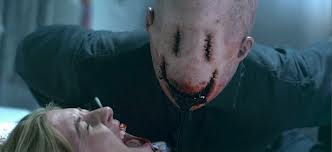
When the titular urban legend, who sports a mask with stitched eyes and mouth, plunged a knife into the heroine (Caitlin Gerard) during one of several nightmare sequences, the youngest child could clearly be heard to sob in fright.

When I reminded an usher that this film was unrated ‒ usually signifying NC-17 material ‒ and totally inappropriate viewing matter for children, he just threw up his hands. Not surprising. The AMC chain brokered a deal with the film’s producers and is releasing and promoting “Smiley” in its major markets. (MPAA alert: Isn’t this a conflict of interest?)

The mother, on the way out, explained: “Oh, we’re friends of Shane (Dawson, who plays the dorky boyfriend). We’re huge fans. We went to Comic-Com to see him. To prepare the girls, we looked at scenes from the film on the Internet. They know it’s all pretend … all in fun.”

At this, the mother shook her head and laughed, as if to say, “Sheesh, buddy, get a life!”

Dawson, of course, has a cult following from his YouTube channel and clever video spoofs. So it’s understandable that kids would anticipate his next big career move, just as an earlier generation flocked to Pee-wee Herman’s first film.

But does that translate into “Hey, grab the little ones, we’re spending the afternoon watching Uncle Shane and others get their throats cut”?

You be the judge.

What would you have done when confronted with children at a slasher film?

Coming to a Theater Near You: Wholesale Paranoia

07/20/2012

by Glenn Lovell

The audience emitted a collective gasp Friday morning as the exit door at the front of a northern California multiplex opened about 30 minutes into “The Dark Knight Rises.”

With CNN updates of the overnight massacre at a theater in Aurora, Colorado, fresh in our minds, those of us in attendance at Santa Clara’s Mercado 20 had our focus snapped when a pool of bright sunlight poured into the auditorium. A figure exited furtively through the door, leaving it slightly ajar for a minute or two, and then reentered ‒ the shooter’s M.O. at the midnight showing of the new Batman movie.

Of course it turned out to be a theater employee doing a security check.

Still, for a moment there, suspecting a copycat crime, our hearts were in our throats.

I’m sure the above scenario will play out at hundreds of theaters around the country this weekend.

And while they won’t admit it, box office analysts are right now wondering how the horrific events in Colorado will affect ticket sales. Will they keep people away from the dour, plenty violent Warner Bros. release co-starring Christian Bale and Anne Hathaway? Will potential ticket-buyers say, “Not on your life ‒ I go to the movies to escape, not to be reminded of a real-life movie massacre!”

Or, God forbid, will the mass shooting add a filament of danger, morbidity, making the new Batman saga all the more alluring to young thrill-seekers?

Warner Bros.’ front office won’t own up to this, but I would wager it’s secretly banking on the latter response. After all, it’s in the business of making money and “The Dark Knight Rises” was highly touted as the summer blockbuster.

To the studio’s credit, it wasted no time yanking most of the trailers for its fall release “Gangster Squad.” The tease includes a St. Valentine’s Day Massacre variation, with gangsters positioned behind a movie screen, spraying an audience with machine-gun fire.

Will the sequence be cut from the feature, much as domestic terrorism scenes was deleted from movies released in the wake of 9/11? Probably. Audiences wouldn’t be able to look at it now without being reminded of the carnage in the Aurora strip mall.

Auteur! Auteur! Andrew Sarris (1928-2012)

06/22/2012

By Glenn Lovell

Andrew Sarris, who died Wednesday at age 83, wrote about movies his entire life but most notably during the 1960s-1970s. It was a heady time, a time of spirited debate over the merits of Bergman, Antonioni and Kubrick. And the scrappy Sarris was at the center of it all, driving and informing the dialogue with his long, rambling, impassioned columns for the Village Voice. The following is an interview I did with Sarris in 1994.

FOR THOSE OF US who began thinking seriously about film in the ’60s, he was the guru, the man who somehow made it all make sense. For his opposite numbers across the Atlantic ‒ Cahiers du Cinéma critics Francois Truffaut and Jean- Luc Godard ‒ he was the chief American proponent of the “auteur theory,” which downgraded Hollywood’s more self-conscious “artists” and made heroes of Howard Hawks, Otto Preminger and especially Alfred Hitchcock.

Sarris

At “65 going on 66,” Andrew Sarris is still hard at it, writing a weekly column for the New York Observer, teaching at Columbia University and putting the finishing touches on his 11th book, “The American Sound Film.”

Sarris, who will be speaking tonight on “The Iridescence of Irene Dunne” (Stanford Theatre, 7:30 p.m.), refers to his latest tome as “my magnum opus.” It was supposed to be out last year, but Sarris being one of the great dreamers and procrastinators pushed the deadline to this summer. “I haven’t done as much as I should have,” he says of his career in general, “but I’m a very late starter.”

Initially, he saw himself as a novelist. But the “real writing” didn’t come. At 27, after a stint in the Army Signal Corps, he submitted a review of “The Country Girl” to Film Culture (“I really panned it”). Remuneration: zilch. But that was OK; he was living with his mother in Brooklyn and working as a script reader for 20th Century Fox.

Four years later, he walked into the editorial offices of the Village Voice, then all of eight pages. Under his arm was a review of Hitchcock’s “Psycho.” Not only was it a rave, it argued that the “master of suspense” should be placed on a pedestal with the likes of Jean Renoir and Ingmar Bergman.

“It caused a great storm,” he recalls from his East Side apartment, which he shares with wife and fellow critic Molly Haskell (also a guest speaker for Stanford’s on-going screwball-comedy series). “I was treating Hitchcock as a major artist. Their idea of an art film was something by Bergman or Fellini. The idea of Hitchcock as a great artist was anathema.”

Those early reviews ‒ now described as “very crude, clumsy” ‒ caused quite a commotion among New York film buffs and left their author with a feeling of euphoria, power. A year later, Sarris began his reign as the Voice’s regular film critic. From 1961 to 1989, he wrote the “Films in Focus” column, which became required reading for fledgling critics and sparked very public feuds with anti-auteurists Pauline Kael and John Simon.

In 1968, Sarris loosed a salvo that reverberated throughout the critical community: “The American Cinema: Directors and Directions.” Beginning with the line, “The need for an updated film history is self-evident,” Sarris juggled the standings of Hollywood’s most celebrated directors. The darlings of the critics ‒ John Huston and Elia Kazan, among them ‒ were lumped under the heading “Less Than Meets the Eye.” Studio workhorses, such as Michael Curtiz and Henry Hathaway, were downgraded to “Lightly Likable.” Cerebral mavericks ‒ Richard Brooks, John Frankenheimer, Stanley Kubrick ‒ were consigned to “Strained Seriousness.”

And the new residents of Sarris’ Pantheon? Such previously underrated entertainers as Chaplin, Keaton, Hawks, Fritz Lang and, of course, Hitchcock. Their personal vision of “a self-contained world” earned them a place beside Orson Welles, F.W. Murnau, D.W. Griffith. Reissued in 1985 with a new afterword by the author, “American Cinema” is required reading in most film aesthetics classes and, along with “What is Cinema?” by André Bazin and the collected reviews of James Agee, a seminal work in film scholarship.

Sarris himself believes the “cult of the auteur” has gone too far. All directors, even the hacks, are revered over screenwriters now. “It was never meant to be the last word, and I was never meant to be a prophet.”

Pressed for changes he would make in his rankings, Sarris says he’d leave the Pantheon category alone, but would be kinder to Wilder, Wellman, Frankenheimer, Leo McCarey, William Wyler.

“I’m always changing. Times change. Movies change. I think differently today than I did when I started out.”

As for the widely hailed Kubrick (“Dr. Strangelove,” “2001: A Space Odyssey”), he’s still an overrated “superego.” Ditto David Lean, whose “Lawrence of Arabia” was panned by Sarris when it opened in 1962. He considered the epic gaseous and pretentious then, and still does.

Sarris’ recent favorites: Stephen Frears’ “The Snapper,” Clint Eastwood’s “Unforgiven,” Harold Ramis’ “Groundhog Day” and (as he’s a dyed-in-the-wool Francophile) anything by Claude Chabrol and Eric Rohmer. Critics who measure up by combining “intelligence and intelligibility”: Kael, Vincent Canby, Richard Corliss, Manny Farber, David Kehr and Haskell (who chronicled her husband’s prolonged hospitalization in ’85 with a mystery virus in the unique memoir “Love and Other Infectious Diseases”).

At a time when many are decrying the state of film criticism ‒ where gossip and the direction of one’s thumb have replaced learned discourse ‒ Sarris is surprisingly upbeat. “I think film criticism has improved enormously,” he says. Sarris’ assessment of his own writing: idiosyncratic, a weakness for alliteration. “I’m lazy ‒ I don’t work hard enough on my writing.” He believes such traits kept him from breaking into mainstream publications. He would have joined The New Yorker or The New York Times (like buddy Canby) “in a second.” He left the Voice, he says, because he was “tired of that atmosphere. It was too political, too radical, for my taste. I’ve always been sort of a centrist, an anomaly.”

The key to his longevity, he believes, is that, for him, film was always a means to an end: self-awareness. “Film enabled me to find myself. Through film, I’ve been telling the story of my life, like an ongoing memoir.”