by Glenn Lovell
As we head out to the local megaplex this weekend, the question on every serious sci-fi buff’s mind: Can 20th Century Fox and Ridley Scott salvage the once-respected “Alien” franchise, dating from 1979 and Scott’s original “Alien,” after the ignominy of desperate sequels like “Alien: Resurrection” (1997) and, worse, those Alien vs. Predator grudge matches (2004, 2007)?
Scott’s “Alien: Covenant,” the second of the director’s planned prequels, following the plodding “Prometheus,” sets down this weekend after a full-court promotional push. Budgeted at around $111 million — or $102 million more than the first “Alien” — the new installment stars Michael Fassbender, Katherine Waterston, Danny McBride and Billy Crudup as real and synthetic cr ew members on the titular spacecraft. Their nebulous mission (something to do with the origins of Man and machine) sounds once again like muddled Kubrick and Arthur C. Clarke.
From the looks of the trailer, however, Scott may have taken a much-welcome sabbatical from the, ahem, existential ramblings of “Prometheus” and “The Martian” and tried a broader “Aliens”/”Starship Troopers” approach. (The hard-R rating for multiple blood-spewing chest-births is another promising sign.) If so, that’s a good thing. After all, the roots of Dan O’Bannon’s original “Alien” script — save for the last-minute casting of a female as second-in-command Ripley — were those sublimely trashy sci-fi’ers of the 1950s, zero-budget quickies about extraterrestrial life forms that stow away in the hull of Earth-bound spaceships. Among our favorites: “It! The Terror from Beyond Space” and, with its pulsing, blob-like blood rust, “Space Master X-7.”
Obviously excited about a balls-to-the-wall scary genre entry that might follow in the slipstream of their campier b.o. behemoth, “Star Wars,” Fox held a New York junket in the spring of ’79 for what was being touted as a horror-science fiction hybrid, an Old Dark House in deep space, if you will. In attendance were members of the cast, including a slender, somewhat androgynous unknown named Sigourney Weaver (she resembled a young but taller Jane Fonda), the 41-year-old Scott (this was only his second feature), and Swiss surrealist H.R. Giger, whose distturbing paintings of phallic-shaped creatures were the inspiration for the drooling stowaway with lethal hydraulic overbite and acid blood that could burn through metal.
Interviews were set for Saturday morning, after the Friday press screening. I was there representing a South Florida paper. My one-off angle, much to the chagrin of studio flacks: For all its creepy extras (industrial functional production design, Jules Verne-retro spacesuits, etc.), “Alien” was really a throwback Saturday-matinee thrill ride. Had Scott and producers David Giler and Walter Hill heard of a 1958 black-and-white programmer called “It! The Terror from Beyond Space”? I asked. They shook their heads no. I ticked off the similarities. “It” has a blood-sucking Martian, which, like their alien, hides in the ventilation ducts of th e ship. Again like their stowaway, the earlier menace is briefly held off with acetylene torch as it works its way from one section of the ship to another, picking off members of the crew … before being flushed into space.
Finally, Giler fessed up that someone in the production had come to a similar conclusion and that, just to be safe, Fox had procured a print of the earlier film and screened it for Scott, Giler, et al. They decided there was nothing to worry about, the two films shared basic genre conventions, nothing more.
Still, besides my opening day backgrounder for the Fort Lauderdale Sun-Sentinel, published in June 1979, I did a sidebar that began “What came first, the creature or the alien egg?” (See ” ‘Alien’ vs. ‘It’: Feud Revisited.) The piece included interviews with Giler, Walter Hill and, over the phone from North Hollywood, “It” screenwriter Jerome Bixby, who, on my prompting, sat through “Alien.” I asked him what he thought. His snap reply, “My lawyer’s on it.” (Nothing came of the threatened suit.)
At the urging of Bill Kelley, the Sentinel’s TV critic and in-house expert on horror and sci-fi, I rewrote the piece for “Cinefantastique” magazine. Though it didn’t make much of an impression at the time, my “It” theory slowly gained traction and converts, to where if you pick up Leonard Maltin’s “Movie Guide” and look up “Alien” you’ll find a reference to the earlier film.
I guess what I’m saying by revisiting this episode is that what has been sorely missing in Scott’s post-“Alien” science fiction — and I’m including “Blade Runner” here — is that sense of good old-fashioned, scary fun, qualities that distinguished the low-budget sci-fi’ers of our misspent youths. Let’s hope this new installment stows the New Age philosophizing and goes for the jugular.
Postscript: While we’re on the subject, I should remind you that “Alien” was not the first feminist sci-fi film. Well before Weaver’s take-charge Ripley, whose decisive stance re protocol would have saved all but three of the Nostromo crew, there were Margaret Sheridan’s Nikki in Howard Hawks’s “The Thing” (1951) and Joan Weldon’s entomologist in the giant ant movie “Them!” (1954). Both proved fully invested participants in the action rather than stereotypical scream queens.
 ces during the space race, is worthwhile if conventional; the second, about a lost boy finally finding his way home, is too baldly manipulative; the third, starring best actor frontrunner Casey Affleck as a brooding New England handyman, is intense but mostly lily white in a year dedicated to diversity.
 for either Amy Adams in “Arrival” or Annette Bening in “20th Century Women.” Streep edged out both actresses after her gutsy anti-Trump speech at the Golden Globes. Suddenly, the actress has morphed into Delacroix’s barricade-storming Liberty Leading the People. Trump helped Streep to a record 20th nomination by lashing out via Twitter the following morning, calling her “a Hillary flunky” and “one of the most overrated actresses in Hollywood.”
 .
. nosticators; it wrangled its way into the best picture, original screenplay, supporting actor (Jeff Bridges), and editing categories — and could very well play spoiler.
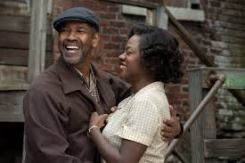 e play in need of “opening up” or great cinema as is. All I know is that this adaptation of the 1983 Wilson play, scene for scene, packs more of an emotional wallop than the rest of this list combined. Washington, who also directed, plays Troy Maxson, a Pittsburgh garbage man and former Negro League slugger whose bitterness at being passed over by the majors and life in general has left him seething inside, a veritable Vesuvius about to blow and bury everyone in his working-class orbit. Washington has never been better onscreen; his fuming, furious Maxson is at once a force of nature and a tragic self-deceiver who’s erecting a metaphorical fence to protect his family from an unjust world. Viola Davis can prepare her Oscar speech; she’s that good as the long-suffering but still girlishly smitten wife, Rose.
 hiller. Robert Eggers’ festival favorite is about a 17th Century wilderness family undone by isolation, sexual frustration and paranoia. Once again we’re reminded that the movies that continue to haunt long after the lights come up deal more in character and atmosphere than machetes through the cranium.
 wing up black and gay in Liberty City, Miami, is structured as three distinct acts. Alex R. Hibbert, Ashton Sanders and Trevante Rhodes play Chiron from 10-year-old to high-schooler to young man. Inevitably, the years of homophobic abuse, from a crack addict mother and bullying classmates, take their toll.
 f Glory,” the World War 1 classic bankrolled by Douglas’s Bryna company and directed by a young Turk named Stanley Kubrick. He was never better or better suited for a role. His Colonel Dax, a French attorney who finds himself defending three soldiers on trial for cowardice, is always moving — as he tours the muddy trenches, leads his men on a suicide charge across No Man’s Land … paces before a military tribunal-cum-kangeroo court.
 s
s 

 modern-day Western about a loner who refuses to be hogtied as being much ahead of its time, a project that, in his words, “oozed integrity.”
 our of the Gun.”

 CinemaDope