Posts Tagged ‘Glenn Lovell’

Peck-‘n-pawed

06/20/2011

Two films, one about to open, the other still on the drawing board.

Both bad ideas.

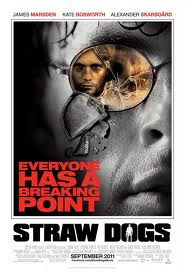
Do we really want to see a redo of Sam Peckinpah’s ultraviolent “Straw Dogs,” this time pairing James Marsden and Kate Bosworth in the Dustin Hoffman-Susan George roles?
Do we really want to see Tom Hanks (white, middle-aged, righteous) battle Somali pirates (black, young, fanatical) in an announced high-seas docudrama that graphs “Black Hawk Down” to “Cast Away”? If Spike Lee hasn’t already spoken out against this project as a potential minefield of Third World stereotypes,  stay tuned.

In 1971, when we were still in Vietnam, Peckinpah’s “Straw Dogs” tapped into something dark and primordial, the lengths to which an ordinary man will go to guard hearth and home … the bloodlust that’s in each of us, whether we want to own up to it or not.

Not surprisingly, “Bloody” Sam was then reading Robert Ardrey’s “Territorial Imperative,” which, for the director, answered questions about why one man shoots another when he steps over a boundary line.

If the trailer for his long-delayed September release is any indication, Rod Lurie is attempting to goose his stalled feature career with a baldly cathartic home-invasion thriller a la “Last House on the Left” and “Cape Fear.” Peckinpah’s rite of passage, whether you bought into it or not (I didn’t), was deeply personal, as much self-justification as self-analysis. Lurie’s updated “re-imagining” smacks of crass commercialism.

While the basic situation and signature battle cry (“I will not allow violence against this house!”) remain intact, Lurie and company have made a number of telling changes. In the original, Hoffman’s David Sumner is a mathematician on sabbatical in Cornwall, England, at its most foreboding. Hoffman, no one’s idea of a classically handsome leading man, made perfect sense. His Sumner was fussy, nattering, preoccupied. The remake takes place in Shreveport, Louisiana, thereby forfeiting much of the stranger-in-a-strange land paranoia. (The novel, “The Siege of Trencher’s Farm,” hinges on British resentment of brash, know-it-all Yanks.) Marsden’s Sumner, besides being a conventional pretty boy, is a struggling screenwriter. (Like the one who came up with that profession?)

British sex kitten George was cast to type as Amy: trashy, dumb, insatiable ‒ every brainiac’s wet dream. As filmed by Peckinpah, the rape scene devolved into consensual seduction, thereby igniting feminist protest and setting a new standard for screen misogyny.

Bosworth looks to be an improvement. Let’s hope Lurie has been sensitive enough to let her screams of “No!” mean no.

Somehow, given its exploitation trappings, I doubt that this remake will rise to the challenge.
Paradise Soon

03/30/2011

Good news, Terrence Malick fans. (Funny how you instantly know who you are.)

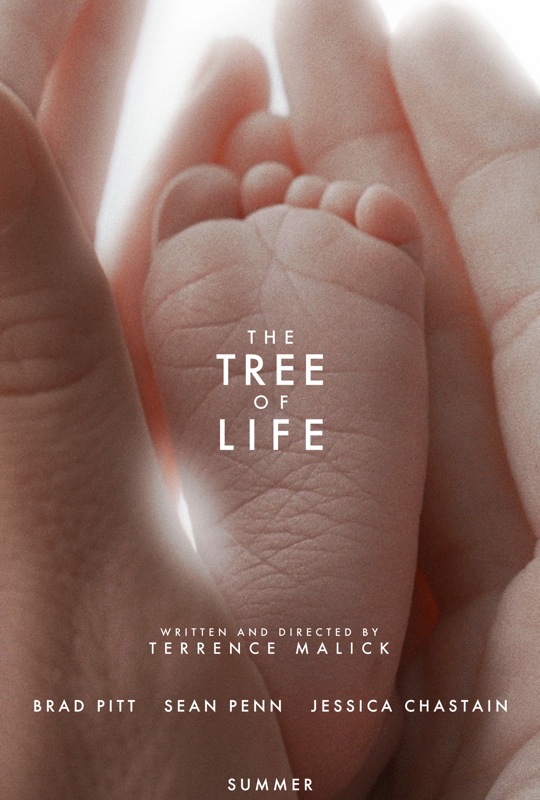
The Howard Hughes of American auteurs is due back this spring with his most personal film yet, “The Tree of Life,” starring Brad Pitt and Sean Penn as, respectively, father and son processing decades of abuse, physical and psychological.

It has been six long years since “The New World,” Malick’s last film. Even so, we can count ourselves lucky: That’s a hiccup after the 20 years that separated “Days of Heaven” (1978) and Malick’s Lazarus-like return, “The Thin Red Line” (1998).

Next to Malick, Stanley Kubrick, whose output consisted of a niggardly 13 features, was a veritable speed demon.

As amazing as it sounds, “The Tree of Life” — which will be platformed out in late May after premiering at Cannes — is only the 67-year-old Malick’s fifth film. But consider the output: “Badlands” (1973), a dazzling snapshot of ’50s America, with Martin Sheen as the Charles Starkweather-inspired sociopath and Sissy Spacek as his reluctant lover-accomplice; “Days of Heaven,” a breathtakingly beautiful tale of Heartland greed and betrayal with Richard Gere, Brooke Adams and Sam Shepard; “The Thin Red Line,” Malick’s sprawling, free-form adaptation of the James Jones novel about one of the bloodiest battles of World War 2; and “The New World,” the Jamestown-Pocahontas story as timely metaphor for the rape of a continent. (Malick’s tableaux of Indians eyeing the advancing British ships with curiosity and apprehension caught the beginning of the end for America’s indigenous people.)

Not a blockbuster — or even a modest hit — among them. Indeed, “Badlands,” coming at the end of the counterculture movement, bowed on the bottom half of double bills. That’s how little Warner Bros. believed in it. (I discovered it in a hole-in-the-wall theater on Olympic Boulevard in Los Angeles.) “Days of Heaven” proved too pictorially studied for many critics and had the added misfortune of opening in New York during a newspaper strike. “The Thin Red Line” was hopelessly mismatched during a release cycle that belonged to the more conventionally structured “Saving Private Ryan.”

Typically, “Tree of Life” has been kept well away from prying eyes. Still, by reviewing Malick’s track record and the new film’s two-minute trailer, we can predict/assume a few things about the director’s latest, including:

1. It will incorporate voiceover narration, lyrical but often unreliable. “Badlands” was narrated by the Holly/Spacek character; “Days of Heaven” was narrated by Linda Manz, who played Gere’s kid sister; “Thin Red Line” and “The New World” came with a Tower of Babel of narrative voices, which contributed to their clutter and confusion.

2. It will chart Man’s Fall from Grace. In “Days of Heaven,” God’s wrath is visited upon the central characters via fire and locusts. In “The Thin Red Line,” it’s delivered  by enemy machine-guns. In “The New World,” European imperialism reaps disease and starvation. In “Tree of Life,” which takes its title from the Book of Genesis, the apocalyptic shock waves begin with children frolicking in DDT spray.

3. At heart, it will be about the pillaging of our planet, the looting of a once-verdant Paradise. Images of despoliation drive and fascinate Malick, who taught us about global interconnectiveness well before Al Gore.

4. It will be impeccably produced and earn Oscar nominations for set designer Jack Fish and cinematographer Emmanuel Lubezki. Malick attracts and gets the best. From the start, his films have been a feast for the senses. “Days of Heaven,” shot during “the magic hour” (the 15 to 20 minutes before dusk), brought Nestor Almendros an Oscar; Lubezki was nominated for “The New World.”

5. If “Tree of Life” doesn’t show early signs of becoming a word-of-mouth hit, it, like every Malick film to date, will be written off by impatient distributors, including Fox Searchlight in the U.S.

6. “Tree of Life” will split audiences and critics. Some will call it transformative, others will damn it as pretentious, self-absorbed. Malick being Malick, he’ll smile and sit back … and disappear until his muse next beckons.